Acoustic Sound Boards help control reflections, reduce flutter echo, and make speech clearer in busy rooms. Their performance depends on more than appearance. Core material, panel thickness, perforation pattern, backing cavity, and installation all affect the result. A wood-finished panel may look convincing, yet perform poorly if it is poorly specified. Small details matter.
Acoustician Professor Trevor Cox has said, “We are all acousticians, whether we know it or not.” That idea fits everyday spaces: a sharp clap in a bare meeting room reveals what a product brochure may not. For buyers comparing China’s manufacturers, this guide considers product range, material options, customization, documented test data, production capability, and communication. These factors help distinguish a reliable supplier from a polished listing. They do not replace independent verification.
The manufacturers featured here serve different needs, from offices and schools to studios and hospitality projects. No single board suits every room. A panel designed for speech may not deliver the low-frequency control a recording space needs. And appearance is only part of the story. Use the list as a starting point, then request test reports, samples, installation details, and project references. Confirm performance against the room’s actual dimensions and goals. This comparison has limits; product specifications can change, and public claims deserve scrutiny. A thoughtful choice begins with evidence, not a ranking alone.
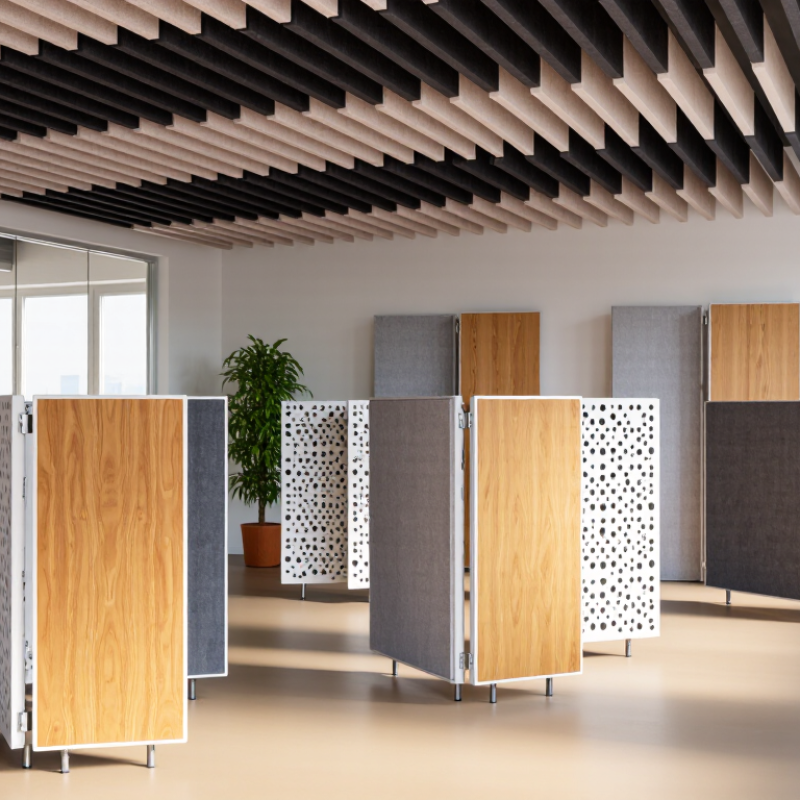
An acoustic sound board is more than a decorative sheet on a wall. Its structure determines how sound interacts with a room. Some boards use perforated or slotted faces, while others combine a solid surface with an absorbent backing. Small holes and narrow gaps can help sound reach the layer behind the panel. The effect depends on the opening pattern, panel depth, and installation.
Materials shape both performance and appearance. Plywood and engineered wood provide firm, workable faces; wood-wool boards have a porous texture. Fabric-covered panels often conceal mineral-fiber or other absorptive cores. Each option behaves differently. A hard face may reflect some sound, while a porous backing can absorb part of it. No single material suits every room.
The core function is usually to reduce reflections and reverberation, not to block all outside noise. In a meeting room, panels near reflective walls can make speech easier to follow. In a music space, placement and room measurements matter as much as panel choice. A specification may look precise, yet the finished room can sound different than expected. That is worth checking. Consider thickness, mounting gaps, and the actual sound problem before selecting a board.
China’s acoustic sound board industry combines material processing, panel fabrication, finishing, and project-based supply. Manufacturers commonly work with wood fiber, mineral-based materials, or composite cores. Production choices affect panel weight, surface texture, durability, and sound absorption. A neat finish does not prove strong acoustic performance. Test data matters.
The market serves offices, schools, studios, hospitality spaces, and residential projects. Demand often depends on renovation cycles, interior design trends, and buyers’ need for custom sizes or finishes. Some suppliers focus on large-volume orders; others handle smaller, tailored batches. Capacity and quality control can vary. The picture is not perfectly uniform.
Buyers should compare absorption ratings, thickness, installation requirements, and sample consistency. Acoustic boards reduce reflected sound; they do not automatically block noise between rooms. That distinction is easy to miss.
Tips: Request test reports for the exact panel specification. Check how edges, joints, and mounting affect performance. Ask for a physical sample. Small details matter.
When evaluating acoustic sound board manufacturers in China, look beyond product photos and quoted prices. Ask for test reports showing sound absorption across several frequencies, not just one headline rating. Check whether the test sample matches the board you plan to order. Thickness, density, perforation pattern, and backing material can all change performance. Small details matter.
Request samples from the actual production range. Compare their weight, surface finish, edge quality, and dimensions with the specification sheet. Then ask how the factory controls batch consistency. Do workers check boards during production, or only inspect finished cartons? A sample can look excellent. Bulk orders may vary. Ask for recent quality records and clear packaging details, especially if boards will travel a long distance. A sound report without traceable sample details is less useful than it appears.
Review the manufacturer’s ability to explain installation requirements, maintenance, and limits in plain language. Ask about lead times, minimum order quantities, and how defects are handled. Verify claims with documents and a video walkthrough, where practical. Price matters, but a low quote may exclude testing, protective packing, or custom sizing. I would not score every supplier with one rigid checklist; project needs differ. Still, written specifications prevent avoidable disputes. Even experienced buyers can miss a detail. Check that the quoted material, finish, and dimensions match the sample you approved.
Suggested evaluation framework: allocate 100 points across these criteria when comparing suppliers. The weights are a practical scoring model, not verified industry statistics or ratings of specific manufacturers.
Ask for test reports identifying the product, test method, and conditions. Compare relevant acoustic performance, material specifications, quality controls, compliance documentation, customization capability, delivery support, and sustainability information.
China’s acoustic sound board sector includes manufacturers with very different strengths. These ten profiles focus on production approaches, not company rankings. Buyers should confirm specifications and test data directly.
One profile specializes in perforated wood boards, where hole spacing and backing affect sound absorption. Another produces fabric-wrapped panels for offices and meeting rooms. A third focuses on mineral-wool boards, often selected for their porous structure. A fourth works with PET-based panels and offers varied colors. Practical choices.
A fifth manufacturer concentrates on custom dimensions for renovation projects. A sixth supplies ceiling boards designed for larger commercial spaces. A seventh combines decorative finishes with acoustic backing. An eighth emphasizes steady output for bulk orders. A ninth offers panels for studios, where room use and placement matter. The tenth provides several board types through one production line, which can simplify sourcing but may limit deep specialization.
A catalog is not proof of performance. Check panel thickness, edge details, installation methods, and test reports. Ask how results were measured; different test conditions can change the figures. Factory visits may reveal finishing consistency, though one sample cannot represent every shipment. Small details matter. Some buyers overlook them.
Acoustic sound boards serve different needs across offices, classrooms, studios, and hospitality spaces. In a meeting room, wall panels can reduce reflected speech and make conversations easier to follow. In a recording space, placement and frequency response matter more than appearance alone. Rooms behave differently. Ceiling height, glazing, and hard floors can change the result, so product selection should start with the space.
Manufacturers may offer perforated wood, fabric-wrapped panels, or porous fiber boards. Perforated surfaces can combine a finished appearance with sound absorption, while porous boards are often selected for broad absorption. Fabric-wrapped options allow more color choices, but fabric, core density, thickness, and mounting method all affect performance. A sample helps, but a small sample cannot fully represent a large installed surface. Small details matter.
When sourcing from China, ask manufacturers for panel dimensions, core materials, installation instructions, and test reports that state the test method and conditions. Compare absorption data on the same basis; different test methods can make figures misleading. Request recent production samples and check edge finishing, color consistency, and packaging. A factory’s stated capacity does not guarantee stable quality across every batch. I would also confirm lead times, customization limits, and replacement-part availability before approving an order. Variations can still occur, so define inspection criteria in writing.
The table compares ten common acoustic-board product categories available from manufacturers and suppliers in China. It is a product-category guide, not a verified ranking of individual companies.
| No. | Supplier Product Category | Typical Construction | Common Applications | Key Product Differences | Sourcing Considerations |
|---|---|---|---|---|---|
| 1 | Polyester fiber acoustic panels | Rigid or semi-rigid panels made from bonded polyester fibers; often available in several thicknesses, colors, and cut shapes. | Offices, classrooms, meeting rooms, studios, and public interiors. | Lightweight and easy to cut or mount; sound absorption depends on thickness, density, mounting, and any air gap. | Confirm panel dimensions, density, edge finish, color consistency, fire-test documentation, and whether the stated acoustic data applies to the proposed installation. |
| 2 | PET felt acoustic boards | Boards or decorative elements made from recycled or virgin PET fiber, commonly supplied as felt sheets, tiles, or shaped panels. | Workplace partitions, wall features, ceilings, and furniture or booth interiors. | Often selected for its felt appearance and fabrication flexibility; thin felt products are not interchangeable with thicker porous absorbers. | Ask for recycled-content evidence if required, color and batch tolerances, thickness measurements, cutting limitations, and fire-performance reports for the exact product. |
| 3 | Wood-slat acoustic panels | Decorative wood or wood-veneer slats fixed over an absorptive backing, commonly with gaps between slats. | Conference rooms, hospitality spaces, residential interiors, and feature walls or ceilings. | Combines a visible timber finish with absorption from the backing; slat spacing and backing assembly affect acoustic performance. | Specify veneer or finish, substrate, slat dimensions, spacing, backing material, installation method, and applicable emissions and fire documentation. |
| 4 | Perforated wood-based panels | MDF, plywood, or other wood-based boards with regularly spaced holes and an absorptive backing or cavity. | Auditoriums, schools, offices, corridors, and commercial interiors. | Perforation pattern and open area influence the system design; the board alone may provide limited absorption without the specified backing and cavity. | Check board thickness, hole diameter and spacing, substrate type, edge treatment, finish, formaldehyde-emissions documentation, and tested assembly details. |
| 5 | Grooved wood acoustic panels | Panels with machined grooves or slots, typically installed with an acoustic backing and sometimes an air space. | Performance spaces, lecture rooms, offices, and interior wall or ceiling systems. | Groove geometry and backing configuration affect the finished system; the visible surface can be coordinated with architectural finishes. | Request shop drawings and confirm groove dimensions, panel tolerances, finish samples, backing specification, installation requirements, and test data for the complete assembly. |
| 6 | Fabric-wrapped mineral wool or fiberglass panels | Porous mineral wool or glass-fiber core enclosed in acoustically transparent fabric, usually with a framed or rigid edge. | Recording and broadcast rooms, offices, theaters, classrooms, and multipurpose spaces. | Porous cores are commonly used for room sound absorption; performance varies with core thickness, fabric, mounting, and air space. | Verify core type and density, fabric acoustical transparency, edge construction, fiber containment, fire classification, and test reports for the finished panel. |
| 7 | Perforated metal acoustic panels | Perforated steel or aluminum face sheets combined with acoustic infill and, in some systems, a backing layer or cavity. | Transport facilities, industrial buildings, sports venues, and durable commercial interiors. | Offers a hard, cleanable face; absorption depends on perforation, infill, backing, and assembly rather than the metal sheet alone. | Specify metal type, gauge, perforation, coating, corrosion requirements, edge details, infill containment, and performance testing for the full panel system. |
| 8 | Mineral-fiber ceiling boards | Factory-made ceiling tiles or boards based on mineral fibers and other formulation components, designed for suspended ceiling grids or compatible systems. | Offices, schools, healthcare facilities, retail spaces, and other commercial interiors. | Designed for ceiling applications and may offer combinations of sound absorption, light reflectance, and humidity resistance depending on the product. | Confirm tile size, edge profile, grid compatibility, sag or humidity limits, cleaning requirements, fire documentation, and applicable acoustic test results. |
| 9 | Open-cell acoustic foam panels | Open-cell polyurethane or other acoustic foam supplied as flat, wedge, or profiled panels. | Small studios, equipment enclosures, practice rooms, and selected interior applications. | Lightweight and easy to shape; foam primarily treats reflections within a room and should not be assumed to provide sound isolation through a wall. | Check foam chemistry, density, dimensions, odor, fire performance, installation method, and suitability for the intended environment; avoid relying on unverified performance claims. |
| 10 | Wood-wool acoustic boards | Boards made from wood strands bonded with a mineral binder, sometimes supplied with an additional backing layer. | Schools, gyms, halls, corridors, and other robust interior or protected exterior applications, subject to product specification. | Has a textured, fibrous appearance and a rigid surface; acoustic performance depends on board thickness, backing, and mounting arrangement. | Confirm binder and board composition, thickness, edge finish, moisture suitability, fixing details, fire documentation, and test data for the intended assembly. |
It reduces sound reflections and reverberation inside a room. It does not block all outside noise.
Perforated faces let sound pass through small holes or slots to an absorbent layer. Porous boards absorb sound through their textured material. Results vary.
Options include plywood, engineered wood, wood-wool, and fabric-covered panels. A firm face and an absorbent core can work together.
Consider the room’s purpose, ceiling height, glazing, and hard floors. Meeting rooms often need clearer speech; studios need careful placement and frequency response. Measure before choosing.
Ask for results across several frequencies, plus the test method and conditions. Confirm that the tested sample matches the board being quoted. One rating is not enough.
Samples let you inspect weight, dimensions, finish, edges, and color. Compare them with written specifications. A small sample cannot represent a large installation perfectly.
Check core materials, panel dimensions, mounting instructions, lead times, customization limits, and packaging. Define inspection criteria in writing. Details get missed.
Ask whether workers inspect boards during production or only after packing. Request recent quality records and a practical walkthrough. Batch consistency still needs checking.
This article explores Acoustic Sound Boards from the inside out, explaining how their structure, surface design, and material choices influence sound absorption, diffusion, and overall room comfort. It also outlines China’s manufacturing landscape, including common production approaches, market characteristics, and the factors that shape product availability and customization.
Readers will find practical guidance for evaluating manufacturers, such as comparing material specifications, acoustic performance data, production capacity, quality controls, and communication practices. The article also introduces ten leading manufacturer profiles without overlooking the needs behind different applications, from offices and schools to studios and public spaces. By comparing product types and considering installation requirements, project budgets, and sourcing priorities, buyers can make more informed decisions and identify solutions suited to their acoustic goals.

Rich New Materials