How to Choose an Acoustic Door Panel in 2026?

Time:2026-10-17 Author:Madeline
0%

Choosing an Acoustic Door Panel in 2026 requires more than comparing catalog ratings. Noise control now affects comfort, concentration, privacy, and perceived building quality. The World Health Organization’s Environmental Noise Guidelines for the European Region link excessive noise with sleep disturbance and other health risks. Its evidence makes one point clear: quiet spaces are not a luxury.

Recent building research supports this direction. Dodge Construction Network’s World Green Building Trends research continues to identify occupant health and wellbeing as major priorities for sustainable projects. However, a high acoustic rating alone does not guarantee a quiet room. The complete door assembly matters, including the panel core, frame, hinges, perimeter seals, and automatic drop seal. Small gaps around the threshold can undermine expensive materials. Very quickly.

Professional specifications should reference recognized testing methods. ASTM E90 measures airborne sound transmission in laboratories, while ASTM E413 helps classify Sound Transmission Class, or STC. ISO 10140 and ISO 717-1 provide related international testing and rating frameworks. These standards improve comparison, but laboratory results may not match site performance. Installation quality remains a stubborn variable.

This guide explains how to assess an Acoustic Door Panel for offices, studios, hotels, healthcare rooms, and industrial spaces. It examines STC or Rw ratings, panel construction, fire and accessibility requirements, hardware compatibility, and lifecycle value. A thicker panel is not automatically better. In some projects, poor sealing matters more than extra mass. That assumption deserves scrutiny. Use certified test reports, confirm the tested assembly, and involve an acoustic specialist when privacy or critical noise control is essential.
How to Choose an Acoustic Door Panel in 2026?

What an Acoustic Door Panel Is and How It Controls Sound

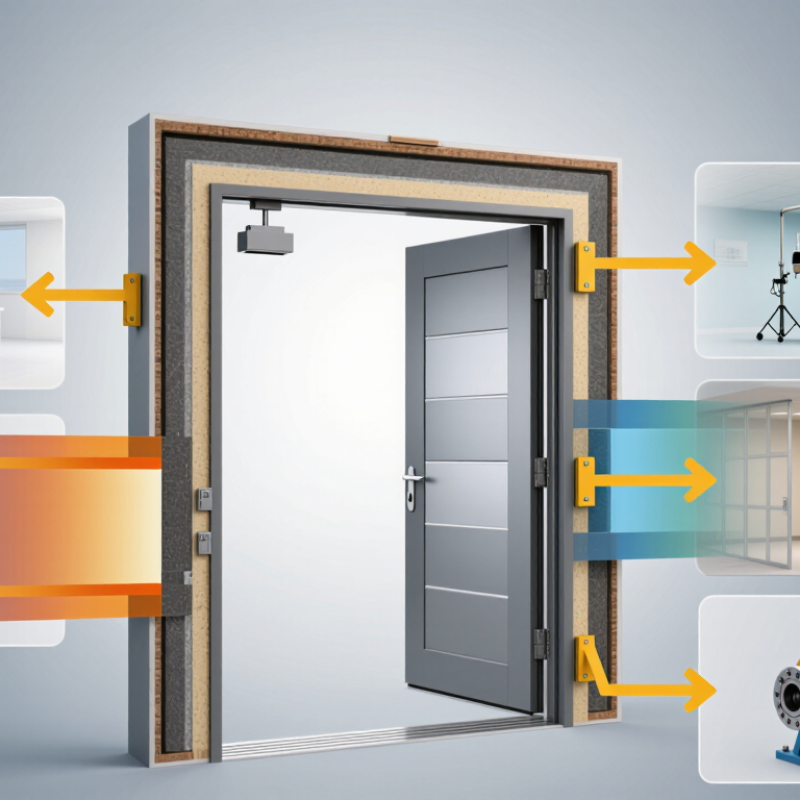
An acoustic door panel is a door leaf designed to reduce sound passing between spaces. It controls noise through mass, airtightness, and layered materials. A dense core resists airborne sound, while flexible layers absorb vibration inside the panel. Perimeter seals close the narrow gaps around the frame. An automatic drop seal protects the space beneath the door.

Sound often escapes through gaps, not the panel itself. Noticeable detail: daylight under a closed door usually signals an acoustic weakness.

Choose the panel according to the noise source and room function. Speech privacy may need a different performance level than music or machinery control. Compare independently tested sound transmission ratings, but treat them carefully.

Laboratory results assume correct installation and matching wall construction. Real rooms may perform worse because of thin partitions, weak frames, or poorly fitted hardware. A high-rated panel cannot repair an unsuitable wall. Check the frame, hinges, threshold, seal compression, and door weight before ordering.

Installation quality deserves equal attention. Measure the opening twice, especially when floors are uneven. The panel should close smoothly without forcing the seals aside. Inspect corners for small gaps. Replace compressed seals when they lose contact.

I would not choose a heavy panel only because its rating looks impressive. That choice may create alignment problems and daily frustration.

Acoustic control is practical, but imperfect. Examine the whole doorway, not just the visible panel.

Which Noise-Control Goals an Acoustic Door Panel Should Meet

When choosing an acoustic door panel in 2026, define the noise-control problem before comparing materials. An office beside a lift needs a different solution from a recording room beside a corridor. Measure the dominant noise first. Speech, traffic, and machinery occupy different frequency ranges.

The panel should reduce airborne sound across relevant frequencies, not only produce an impressive laboratory rating. Check its tested Rw or STC value, then examine the complete door assembly. The frame, seals, hinges, and threshold can weaken performance. A small gap beneath the door may allow voices to remain clearly understandable. Ask for laboratory data from recognized testing methods, such as ISO-based procedures. Panel-only claims can be misleading.

I would also inspect the door’s compression seals by hand. They should close evenly without requiring excessive force. In busy buildings, seals often wear faster than expected. This detail is easy to miss. Consider impact noise, too, if corridors contain carts or heavy equipment. A dense panel may control airborne sound well but perform poorly against structure-borne vibration. Higher ratings are not always better. Extra mass can increase cost, weight, and maintenance demands. The best choice matches the room’s noise source, operating frequency, available space, and daily use. Even careful specifications need field verification, because installation quality can differ from the test setup.

How to Compare Core Materials, Seals, Frames, and Surface Finishes

Choosing an acoustic door panel in 2026 starts with the tested assembly, not the decorative panel alone. The World Health Organization’s Environmental Noise Guidelines recommend indoor night noise below 30 dB LAeq in bedrooms. That target makes small leakage important. Compare laboratory STC or Rw values under ASTM E90, ASTM E413, or ISO 10140. A rating without its test configuration is incomplete. I have seen specifications quote a strong core while ignoring the frame and threshold.

Core material controls mass, damping, and fire strategy. Mineral fibre, composite, and engineered timber cores behave differently across low frequencies. Ask for the full frequency spectrum, not only one STC number. Seals deserve equal attention. Continuous compression gaskets should meet evenly at corners, while a drop seal must close against a clean, level floor. A two-millimetre gap can undermine an expensive panel. That detail is easy to miss.

Frames should match wall density and construction. A rigid frame in a lightweight partition may transfer vibration around the door. Check jamb anchoring, reveal tolerances, and field results under ASTM E336. Surface finishes affect durability, cleaning, and panel weight; they rarely repair poor acoustics. Choose textured or perforated finishes only when the backing system preserves airtightness. Laboratory reports are useful, but site conditions remain less predictable. I would revise any selection after witnessing installation. The first drawing is rarely the final acoustic truth.

How to Choose an Acoustic Door Panel in 2026? — Comparing Core Materials, Seals, Frames, and Surface Finishes
Component Option Typical Acoustic Performance Fire and Moisture Characteristics Durability and Maintenance Recommended Applications Main Limitations
Core Material Mineral wool High when combined with a heavy, well-sealed leaf Generally non-combustible; resistant to decay. Moisture resistance depends on the facing and edge protection. Stable over time when properly enclosed; the core must be protected from compression and water exposure. Fire-rated acoustic doors, plant rooms, corridors, studios, and commercial buildings. Performance varies with density, thickness, facings, and the complete door assembly; it is not automatically fire-rated.
Solid timber, MDF, or particleboard Medium to high due to high surface mass Combustible unless specially engineered and certified; can swell if exposed to persistent moisture. Good impact resistance; edges and cut-outs require sealing to limit moisture absorption. Offices, hotels, meeting rooms, classrooms, and general interior applications. Heavy weight may increase hinge and frame loads; acoustic performance falls sharply if perimeter or threshold gaps remain.
Polyurethane or polyisocyanurate foam Low to medium as a standalone core Moisture-resistant in closed-cell formulations; fire behavior depends on formulation, facings, and certification. Lightweight and dimensionally stable; must be protected from heat, flame, and mechanical damage. Lightweight doors, service areas, and projects where thermal insulation is also required. Low mass can limit low-frequency sound insulation; acoustic results should be verified by laboratory testing.
Honeycomb paper or aluminum Low unless combined with additional mass and damping layers Paper honeycomb is combustible; aluminum is non-combustible, but the full construction determines fire performance. Lightweight; aluminum is moisture-resistant, while paper cores require protection from water. Good dimensional stability and reduced door weight; limited resistance to concentrated impact. Light-duty interior doors where weight and cost are more important than high sound insulation. Usually unsuitable for high acoustic ratings without added solid layers and carefully designed seals.
Composite mass-and-absorber core High potential when engineered as a complete tested assembly Can be designed for specific fire and moisture requirements using compatible layers and protective facings. Performance depends on bonding, layer stability, edge treatment, and manufacturing quality. Suitable for demanding projects requiring a balance of mass, damping, and internal absorption. Higher cost and greater design complexity; individual materials cannot predict the final rating.
Seals and Thresholds Continuous compression seal Essential for controlling air leakage around the head and jambs EPDM and silicone are commonly selected for good weathering and temperature resistance; fire-rated doors require approved seal types. Inspect for cracking, hardening, shrinkage, and loss of compression; replace when gaps become visible. Most acoustic doors, especially offices, studios, healthcare spaces, and hospitality areas. Over-compression can increase closing force and accelerate wear.
Automatic drop seal High importance because the threshold is a frequent leakage path Available in smoke- and fire-tested configurations; floor conditions must be compatible with the seal. Protects against light drafts and sound leakage at the bottom edge; performance depends on a level floor. Hidden when the door is closed; adjustment and replacement are periodic maintenance tasks. Rooms requiring a clean appearance, accessible thresholds, or reduced trip hazards. Uneven floors, carpets, or excessive gaps can prevent full contact and reduce performance.
Fixed threshold with compression seal High when a continuous contact line is maintained Can support smoke and fire performance when included in the tested door assembly. Provides a durable sealing surface and can improve resistance to drafts and light water ingress. Simple and robust; threshold edges may need cleaning and periodic inspection. Industrial, plant, acoustic test, and high-performance interior applications. May create an accessibility or trip issue if the threshold height is not carefully designed.
Magnetic or multi-fin sealing system High potential with precise installation and compatible hardware Material selection and fire approval must be verified for the specific assembly. Can provide consistent contact pressure and good resistance to air leakage. Requires accurate alignment; damaged or contaminated seal surfaces can reduce effectiveness. Recording rooms, laboratories, conference rooms, and high-specification acoustic spaces. Higher cost and greater sensitivity to door alignment than basic compression seals.
Frame Material Welded steel frame High potential because of rigidity and mass Non-combustible; corrosion protection is required in damp or chemically aggressive environments. Strong and stable; damaged coatings should be repaired to prevent corrosion. Industrial facilities, fire doors, studios, plant rooms, and high-traffic buildings. Heavier installation and possible thermal bridging; poor anchoring can undermine acoustic performance.
Pressed steel frame Medium to high depending on profile, reinforcement, and installation Non-combustible; protective coating selection should match humidity and exposure conditions. Cost-effective and durable when adequately reinforced and protected. Commercial interiors, corridors, service rooms, and standardized door systems. Thin or poorly reinforced profiles may transmit vibration or distort under heavy door loads.
Aluminum frame Medium; improved by thermal breaks, reinforced profiles, and continuous seals Non-combustible and corrosion-resistant; not every aluminum system is suitable for fire-rated applications. Lightweight, clean-looking, and low-maintenance; compatible with many glazed or contemporary interiors. Commercial offices, public buildings, partitions, and moderate acoustic requirements. Lower mass and higher flexibility can limit sound insulation compared with a robust steel frame.
Engineered timber frame Medium to high when stable and tightly sealed Combustible unless part of a tested fire-rated assembly; must be protected from excessive humidity. Warm appearance and easy coordination with wood doors; requires control of moisture and movement. Hotels, residential buildings, offices, and interior architectural applications. Seasonal movement, gaps, and weak fixing points can reduce seal compression and acoustic performance.
Surface Finish High-pressure laminate Acoustically neutral; the core and seals provide most of the sound insulation Good resistance to stains, abrasion, and routine cleaning; moisture resistance depends on edge treatment. Durable and easy to clean; damaged areas are difficult to repair invisibly. Healthcare, education, hospitality, offices, and high-use circulation areas. Edges and joints must be detailed carefully to prevent moisture penetration and delamination.
Natural wood veneer Acoustically neutral when applied over a suitable leaf Combustibility and fire performance depend on the substrate and coating system; humidity control is important. Premium appearance; may require refinishing and protection from impact, sunlight, and moisture. Hotels, executive offices, residential interiors, and architectural projects. Less resistant to scratches and moisture than many laminates or metal finishes.
Painted steel Acoustically neutral to slightly beneficial when used as a substantial facing Non-combustible substrate; coating system must be suitable for humidity, cleaning, and corrosion exposure. Strong and cleanable; chips and scratches should be repaired to maintain corrosion protection. Industrial, healthcare, utility, and high-traffic environments. Can show dents and surface damage; color matching and on-site touch-up may be visible.
Powder-coated metal Acoustically neutral; final results depend on door mass and sealing Durable coating with good resistance to abrasion and corrosion when correctly specified. Low routine maintenance and consistent appearance; field repairs can be difficult to blend. Commercial, transportation, institutional, and demanding service environments. Edges, cut-outs, and damaged areas require careful treatment to prevent corrosion.
Vinyl or PVC-faced finish Acoustically neutral when properly bonded Good cleanability and moisture resistance; fire and smoke behavior must be checked for the exact product. Soft, resilient, and available in many colors; seams and edges can be vulnerable to peeling or impact. Healthcare, hospitality, education, and interiors requiring frequent cleaning. Not suitable for every fire-rated application; strong chemicals and sharp impacts may damage the surface.
Selection note: Acoustic performance is determined by the complete door-and-frame assembly, not by the panel material alone. Compare laboratory-tested ratings such as Rw or STC, confirm the test standard and configuration, and check the installation details, hardware, perimeter seals, threshold, glazing, and wall connection before making a final specification.

How to Match Panel Ratings with Room Use and Installation Conditions

How to Choose an Acoustic Door Panel in 2026?

Match the panel rating to the room’s actual sound problem. A small office may need speech privacy rather than complete silence. A meeting room usually benefits from a higher sound transmission rating, such as STC or Rw. Music rooms need careful low-frequency control, which a single rating may not fully describe. Check the test report, not only the product label.

Installation conditions can change performance dramatically. A strong panel cannot compensate for a hollow frame or an uneven threshold. Inspect the wall construction, door weight, hinges, perimeter seals, and drop seal before selecting the panel. Keep the sealing surfaces clean and continuous. Even a narrow gap under the door can carry noticeable speech. The door assembly should be tested as a complete system whenever possible.

In practice, I have seen buyers choose the highest rating and still receive poor privacy. The panel was suitable, but the frame was not. That was an avoidable mistake. Site measurements also matter. Identify nearby equipment, reflective surfaces, and ventilation openings before installation. A compact consultation room may need moderate isolation and better sealing, while a studio may require heavier construction. Do not assume laboratory results equal field performance. Installation quality is often the weaker link. Review the rating again after installation, because real rooms rarely behave perfectly.

How to Choose an Acoustic Door Panel in 2026?

Match Panel Ratings with Room Use and Installation Conditions

The chart shows typical minimum airborne sound insulation targets for complete acoustic door assemblies. Higher STC values indicate greater resistance to airborne sound transmission.

Treat these figures as planning ranges rather than certification values. The final result depends on the door leaf, frame, perimeter seals, threshold, wall construction, installation tolerances, and field conditions. The door assembly should be tested or specified to match the surrounding wall performance.

How to Check Performance, Safety, Durability, and Long-Term Value

How to Choose an Acoustic Door Panel in 2026?

An acoustic door panel should be judged by tested performance, not appearance. Ask for laboratory results under ASTM E90 or ISO 10140. These methods measure airborne sound transmission under controlled conditions. However, a laboratory rating does not guarantee quiet performance onsite. Small gaps below the door can undermine an otherwise strong assembly. I have seen impressive specifications fail because seals were poorly adjusted.

Check the complete door system, including the frame, hinges, drop seal, and wall connection. The World Health Organization recommends keeping road traffic noise below 53 dB Lden and 45 dB Lnight. These figures show why sound control affects more than comfort.

For safety, confirm the required fire rating through recognized testing, such as furnace and hose-stream procedures under applicable standards. Hardware should allow reliable emergency operation. Heavy panels are not automatically safer.

The World Health Organization recommends keeping road traffic noise below 53 dB Lden and 45 dB Lnight.

Durability requires evidence. Request cycle-test results, seal replacement guidance, corrosion information, and cleaning instructions. A panel exposed to frequent opening may lose performance when its compression seal hardens. That detail is easy to miss.

Review the expected service life and maintenance cost, not only the purchase price. A lower-cost panel may demand earlier seal replacement. Sometimes, the cheapest quote is simply incomplete.

Keep test reports, installation records, and inspection dates. Long-term value depends on correct installation, measurable maintenance, and performance that remains credible after years of use.

FAQS

How should an acoustic door panel rating match the room’s purpose?

Match the rating to the actual sound problem. A small office may need speech privacy, not complete silence. Meeting rooms often need higher STC or Rw performance. Music rooms require careful low-frequency control. One rating may not explain everything.

Why can a highly rated panel still perform poorly?

The frame, hinges, seals, or wall connection may be weak. A narrow gap beneath the door can carry noticeable speech. Gaps matter. The panel may be suitable, but the complete assembly may not be.

What should be inspected before selecting a panel?

Check the wall construction, door weight, hinges, perimeter seals, threshold, and drop seal. Measure the opening carefully. Note ventilation openings, nearby equipment, and reflective surfaces. Small site details can change the result.

Are laboratory ratings the same as real-world performance?

No. Laboratory tests use controlled conditions. Real rooms contain uneven floors, gaps, ventilation paths, and reflective surfaces. Field performance is often lower. I would review the rating again after installation.

What test information should buyers request?

Request laboratory results from recognized airborne-sound transmission methods. Ask whether the complete door assembly was tested. A panel-only report may not represent the installed system. That difference is easy to miss.

How do seals affect long-term acoustic performance?

Seals must remain clean, continuous, and properly compressed. Frequent opening can harden or damage them. A worn seal may reduce privacy before the panel appears damaged. Not always obvious.

What safety details should be checked?

Confirm the required fire rating through recognized testing. Check that hardware supports reliable emergency operation. Heavy construction does not automatically mean safer operation. The full assembly matters.

How can buyers judge long-term value?

Review cycle-test results, seal replacement guidance, corrosion information, cleaning instructions, and expected service life. Include maintenance costs in the comparison. The cheapest quote may be incomplete. That was avoidable.

Conclusion

Choosing an Acoustic Door Panel in 2026 requires more than selecting a thick or heavy door. It should be designed to control sound by combining a suitable core, tight seals, a stable frame, and a properly fitted surface. First, identify the main noise-control goal, such as reducing speech transfer, equipment noise, or sound leakage between rooms. Then compare materials for their density, resilience, moisture resistance, fire performance, and expected service life.

The right panel rating should match the room’s purpose and installation conditions, whether it is used in an office, studio, classroom, healthcare space, or industrial area. Check independent performance data, door-set compatibility, safety features, and ease of maintenance before making a decision. A durable Acoustic Door Panel should remain effective after repeated use, resist warping and seal wear, and support long-term value through reliable performance, practical installation, and reasonable upkeep.


Madeline

Madeline

Madeline is a dedicated marketing professional with a wealth of expertise in our company's core offerings. With a keen understanding of the industry, she brings a unique perspective to her role, consistently delivering high-quality content that highlights the superior aspects of our products. As......