China has become a major source of Outdoor Wpc Decking for residential, commercial, and hospitality projects. Its manufacturers serve buyers across many climates and construction markets. However, choosing a reliable supplier requires more than comparing factory photos or advertised prices.
This guide examines ten leading Chinese manufacturers through practical purchasing criteria. These include material composition, surface texture, production capacity, quality controls, customization options, export experience, and after-sales support. Product samples matter. A deck board should be checked under real sunlight, moisture, foot traffic, and temperature changes. Small details often reveal more than polished brochures.
Performance varies.
Some suppliers focus on affordable hollow boards, while others produce capped or co-extruded decking for demanding environments. Manufacturing experience can influence color consistency, dimensional stability, and installation accuracy. Certifications and test reports should also be reviewed carefully, because documents may differ in scope and validity. Factory visits, independent inspections, and clear warranty terms can reduce avoidable risks.
This overview is designed for importers, distributors, architects, contractors, and property owners seeking dependable information. It does not treat every manufacturer as equally suitable. A factory with strong export records may still be a poor fit for a specialized project. Likewise, a smaller producer may offer better communication or customization. The ranking is therefore a practical reference, not an absolute judgment. Buyers should verify current specifications, production conditions, and project references before signing a contract. Even experienced purchasers can miss details. That is why careful comparison remains essential.
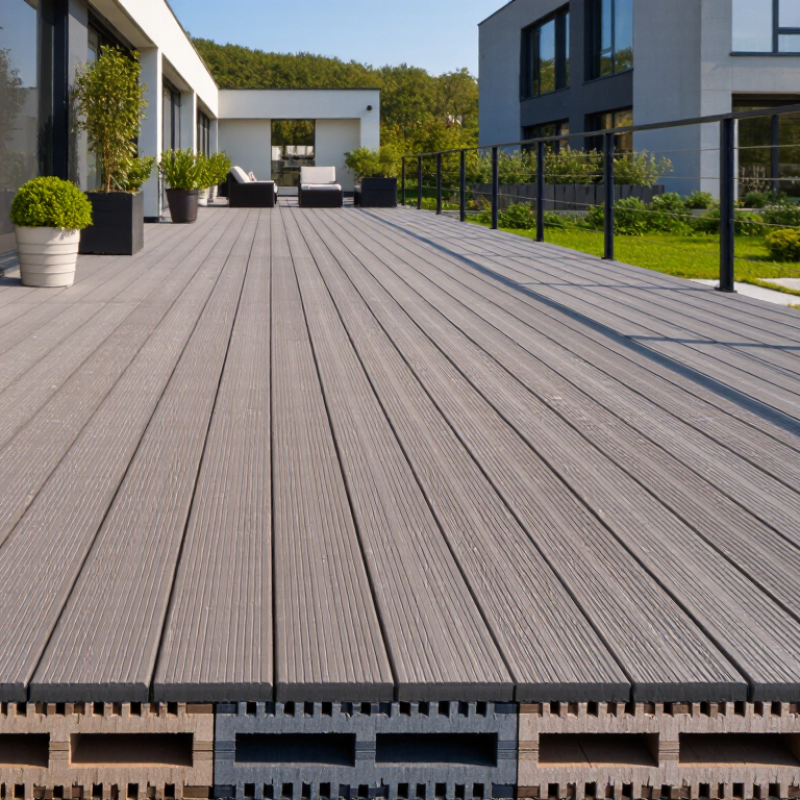
Outdoor WPC decking combines wood fibers with recycled plastic and performance additives. The result resembles timber but resists moisture, insects, and daily surface wear. When comparing China’s top ten outdoor WPC decking manufacturers, buyers should examine more than appearance. Core density, water absorption, slip resistance, and warranty terms reveal product quality. A solid board should feel stable underfoot, not hollow or unusually flexible. Real installation experience also matters because poor joist spacing can cause bending, even with reliable boards.
Tips: Request test reports and installation instructions. Check color consistency across samples. Ask how the surface performs after repeated wetting, sunlight, and temperature changes. Leave expansion gaps around walls and fixed structures. Small details prevent expensive repairs.
WPC decking still has limitations. Dark colors may become hot in direct summer sunlight. Scratches can remain visible, and low-quality boards may fade unevenly. No material is perfect. This deserves honest attention. Professional suppliers should explain maintenance, drainage, fastening systems, and local climate suitability. A trustworthy manufacturer also provides batch information and clear technical data, rather than relying on attractive photographs. For balconies, pool edges, and garden paths, these details affect safety, comfort, and service life.
China’s leading WPC decking manufacturers should be evaluated through evidence, not online rankings. Grand View Research estimated the global wood-plastic composites market at about USD 7.1 billion in 2023. This growth attracts capable factories and weak imitators. A polished sample proves little. Request production-line photographs, batch records, and recent independent test reports.
Ask about wood-fiber content, polymer type, additives, and recycled-material controls. Then compare flexural strength, water absorption, slip resistance, color retention, and thermal expansion. ASTM D7032 provides performance requirements for many WPC decking products, while ASTM D7031 offers evaluation guidance. Reports should identify the tested product and test date. Generic certificates are warning signs.
Examine extrusion stability, mold maintenance, cooling systems, and packaging protection. Measure several boards from different batches. Small variation matters during installation. Confirm production capacity using real monthly records, not impressive machinery counts. Also review moisture management, ultraviolet exposure testing, warranty terms, and replacement procedures. My early screening mistake was trusting a low price too quickly. It later created hidden costs through warped boards and delayed replacements. Price still matters, but total installed cost is more honest. Third-party audits and traceable documentation provide stronger confidence than sales language.
China’s Top 10 Outdoor WPC Decking Manufacturers
China’s top ten outdoor WPC decking manufacturers are often judged by more than production size. Experienced buyers examine material consistency, surface finish, and outdoor testing records. Reliable factories usually provide clear profiles, installation drawings, and batch inspection reports. Their decking may combine recycled wood fiber, polymers, pigments, and stabilizers. This composition affects moisture resistance, color retention, and board movement. A deck should feel firm underfoot, not hollow or excessively flexible. Samples can reveal uneven embossing, rough edges, or weak clip channels.
Practical experience still matters. Ask manufacturers about extrusion temperature control, hidden fastening systems, and replacement support. A capable technical team can explain expansion gaps for changing temperatures. It should also discuss drainage beneath the deck, especially on balconies and poolside areas. Some suppliers publish impressive test data, but field conditions can differ. I have seen attractive samples fade faster than expected when exposed to strong sunlight. That possibility deserves honest discussion. A small trial order may prevent an expensive mistake.
Tips: Request samples from several shortlisted manufacturers. Compare board weight, color variation, slip resistance, and cutting behavior. Check whether test reports match the exact product series. Confirm packaging details before shipment, including corner protection and moisture barriers. Ask for installation guidance in writing. Good communication is useful, but consistent documentation is more dependable.
Outdoor WPC decking technical benchmark ranges commonly used when comparing Chinese suppliers.
The chart compares commonly specified dimensions for outdoor WPC decking and installation systems, including board size, joist spacing, expansion allowance, and clip spacing. Actual specifications vary by profile design, loading requirements, climate, and supplier documentation.
When comparing China’s outdoor WPC decking manufacturers, quality begins with controlled production, not attractive catalog images. Experienced buyers should inspect wood-plastic ratios, extrusion consistency, and surface finish. A reliable factory can provide test reports for water absorption, slip resistance, color fading, and load performance. Samples should be checked outdoors, not only under showroom lights.
Value becomes clearer after installation. A lower quotation may hide uneven boards, weak clips, or excessive color variation between batches. Strong manufacturers usually offer stable dimensions, clearer quality controls, and packaging that protects edges during long-distance shipping. Their decking may cost more initially, yet reduce replacement work and installation delays. Ask about recycled material sources, maintenance requirements, lead times, and warranty terms. Details matter.
A practical test is simple. Leave sample boards in sun and rain for several weeks. Check swelling, fading, surface splinters, and hidden warping. I have seen attractive samples fail after poor storage. That is an uncomfortable reminder: factory quality cannot repair careless handling. Some suppliers also need improvement in communication, especially when technical drawings change. Buyers should request signed specifications and approve a production sample before mass manufacturing. The best value is not the cheapest square meter. It is predictable performance, documented honestly, with fewer surprises on site.
China Top 10 Outdoor WPC Decking Manufacturers: What to Check Before Choosing a Chinese WPC Decking Supplier
A top-ten list is only a starting point. Supplier selection requires evidence, not attractive product photos. Request factory details, production capacity, export experience, and recent project references. A reliable manufacturer should explain its wood-plastic ratio, core structure, surface treatment, and expected service conditions clearly. Ask for samples from current production, not specially prepared pieces.
Check technical performance carefully. Compare slip resistance, water absorption, color stability, screw holding, thermal expansion, and load capacity. Independent test reports are useful, but verify the testing scope and dates. Review quality-control records for dimensions, surface defects, and batch consistency. A polished website can still hide uneven production. Small sample differences may become obvious across a large terrace. That detail is easy to miss.
Tips: Place samples outdoors for several weeks. Measure color change, warping, surface temperature, and drainage after rain. Ask how complaints are handled, including replacement procedures and response times. Confirm packaging, labeling, lead times, and spare quantities in writing. Visit the factory when possible, or arrange a live production inspection. No supplier is perfect. The important question is whether problems are acknowledged, documented, and corrected. Be cautious when answers remain vague.
Supplier evaluation checklist based on measurable product, compliance, manufacturing, and service criteria
| No. | Evaluation Dimension | Evidence to Request | Practical Benchmark or Reference | Selection Signal |
|---|---|---|---|---|
| 1 | Product composition and consistency | Technical data sheet stating wood-fiber type, polymer type, additives, profile dimensions, density, and permitted production tolerances. | The formulation and tolerances should remain consistent between samples, purchase orders, and mass production. | Clear specifications with no unexplained changes. |
| 2 | Mechanical performance | Independent or in-house test results for flexural strength, flexural modulus, screw holding, and impact resistance. | ASTM D7031 and ASTM D7032 are commonly used references for evaluating and specifying wood-plastic composite decking. | Reports identify test method, specimen direction, conditioning, date, and laboratory. |
| 3 | Water absorption and dimensional stability | Water-absorption, thickness-swelling, moisture-conditioning, and thermal-expansion test data. | Compare results using the same conditioning time, temperature, specimen size, and calculation method; do not compare isolated percentages. | Low variation after wet-dry and heat-cold cycles. |
| 4 | UV, weathering, and color retention | Accelerated-weathering report, pigment or cap-layer details, and before-and-after color photographs. | ISO 4892-3 or an equivalent recognized weathering method can be used for comparative testing; exposure duration must be stated. | Color-change results are reported objectively rather than described only as “fade resistant.” |
| 5 | Slip resistance and surface safety | Wet and dry slip-resistance test results for the exact surface texture and finish being quoted. | The applicable test standard depends on the destination market; results should state footwear, water condition, pendulum or ramp method, and surface orientation. | Testing covers the actual outdoor surface, not an unrelated indoor sample. |
| 6 | Fire and chemical compliance | Fire-classification report and declarations for restricted substances, coatings, pigments, and preservatives. | Fire requirements vary by country and building application; use the destination market’s required test and classification system. | Documents are issued for the same product code and current formulation. |
| 7 | Quality-control system | Factory audit, incoming-material records, first-piece approval, in-process inspection, final inspection, and corrective-action records. | ISO 9001 certification can support process control, but it does not replace product-specific testing or an on-site audit. | Inspection records are traceable by batch, date, and production line. |
| 8 | Production capacity and tooling | Extrusion-line count, profile tooling list, monthly capacity, shift pattern, maintenance records, and capacity reserved for the order. | Capacity should be demonstrated with production records rather than a catalog statement; tooling must match the approved profile. | The supplier can explain lead time, bottlenecks, and contingency plans. |
| 9 | Packaging, logistics, and export documentation | Packing specification, loading photographs, carton or pallet dimensions, HS-code proposal, commercial invoice, packing list, and shipping terms. | Packaging should protect edges and surfaces from abrasion, moisture, bending, and container movement. | A trial shipment can be inspected for damage, quantity accuracy, and documentation quality. |
| 10 | Warranty, installation guidance, and after-sales support | Written warranty terms, exclusions, installation manual, joist-spacing requirements, maintenance instructions, spare-profile policy, and complaint procedure. | Warranty coverage should define duration, application limits, installation conditions, color expectations, and the evidence required for a claim. | The supplier provides technical support before purchase and a documented claim-resolution process. |
It combines wood fibers, recycled plastic, and performance additives. It looks like timber but resists moisture and insects.
Examine core density, water absorption, slip resistance, load performance, and warranty terms. Do not trust photographs alone.
Place samples outdoors for several weeks. Expose them to sunlight and rain. Check fading, swelling, splinters, and warping.
Incorrect joist spacing can cause bending, even with strong boards. Follow the supplier’s instructions and leave expansion gaps.
Request test reports, technical drawings, batch information, and signed specifications. Approve a production sample before mass manufacturing.
Not always. Cheap boards may create replacement work, weak fastening, color variation, or installation delays.
Dark boards can become hot in direct summer sunlight. Scratches may remain visible. Low-quality boards may fade unevenly.
Check communication, packaging, lead times, maintenance guidance, and warranty terms. I would also question unclear technical changes.
It suits balconies, pool edges, garden paths, and similar outdoor areas. Drainage and slip resistance still need careful attention.
No. Poor storage can damage attractive samples before installation. That uncomfortable detail deserves more attention.
This article provides a practical guide to China’s Outdoor Wpc Decking industry, explaining what wood-plastic composite decking is, how it performs in outdoor environments, and why factors such as durability, weather resistance, maintenance, safety, and sustainability matter. It also outlines a clear method for evaluating manufacturers, including material composition, production capabilities, quality-control procedures, customization options, certifications, delivery reliability, and after-sales support.
A carefully selected list of China’s top 10 Outdoor Wpc Decking manufacturers is presented through objective comparison rather than brand promotion. The article examines how suppliers differ in product quality, design flexibility, pricing, technical service, and overall value. Before making a purchasing decision, readers are encouraged to verify samples, specifications, testing documents, warranty terms, order capacity, packaging, communication standards, and export experience. These checks can help buyers choose a dependable supplier that meets project requirements and delivers consistent long-term performance.

Rich New Materials