Choosing the right Acoustic Slat Panels starts with a simple question: what problem should they solve? In a home office, the goal may be clearer speech during calls. In a restaurant, it may be less clatter between tables. Panels can absorb some reflected sound, but they do not automatically block noise passing through walls or windows. That distinction matters.
The World Health Organization’s Environmental Noise Guidelines for the European Region (2018) recommend keeping average road-traffic exposure below 53 dB Lden and nighttime exposure below 45 dB Lnight. These are environmental-noise benchmarks, not product ratings for indoor panels. Still, they underline why buyers should assess the room, noise source, and intended result before comparing finishes. For panel performance, look for test data such as sound absorption results measured under ASTM C423, and check the tested assembly—not just the slat surface.
Sound expert Julian Treasure offers a useful reminder: “We are losing our listening.” His line is about listening, not a product endorsement. But it points to the real purpose of acoustic treatment: making a space easier to hear in. Look beyond attractive oak or walnut slats. Compare the backing material, coverage area, installation method, fire documentation, and verified acoustic data. Ask for the test report. Check the details.
There is no universal “top” panel. A beautiful sample can still disappoint in a lively room, and published ratings may not predict every installation. The best choice depends on measurable performance, practical fit, and honest expectations.
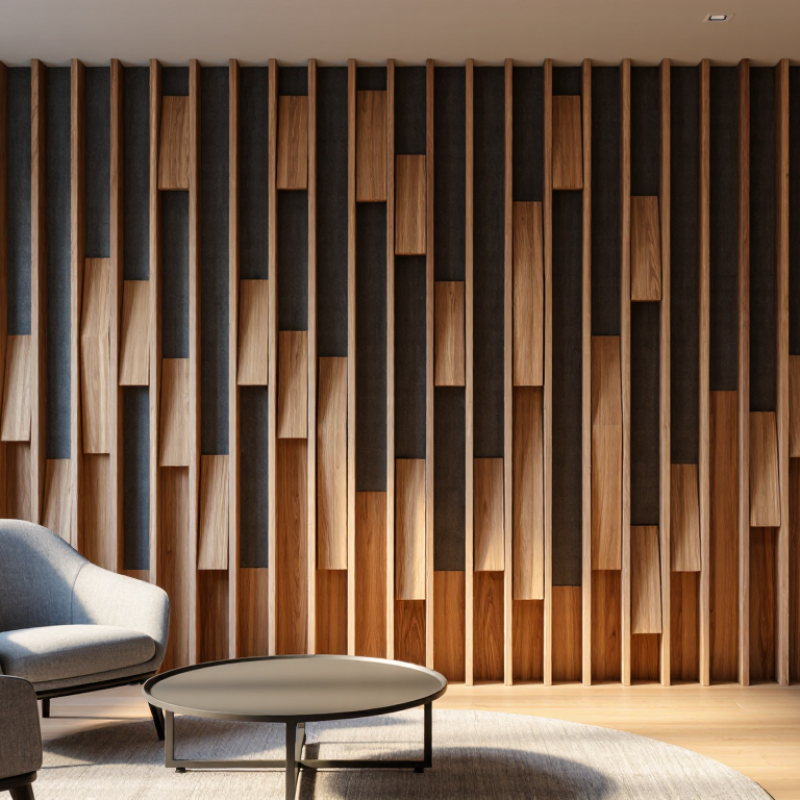
Acoustic slat panels usually pair narrow wood or wood-look strips with an absorptive backing, often felt. The slats scatter some reflections, while the backing absorbs part of the sound energy. This can reduce reverberation, the lingering “ring” heard after speech or a hand clap. It does not make a room soundproof. Low-frequency bass may still pass through or build up, especially in a room with hard floors and little soft furnishing. That distinction matters.
Performance depends on the panel, its backing, the air gap behind it, and the room itself. ASTM C423 measures sound absorption in a reverberation room; product reports may give a Noise Reduction Coefficient (NRC), an average across selected frequencies. Check the test setup, not just the headline number. For context, ANSI/ASA S12.60 sets a 0.6-second reverberation-time limit for small classroom core learning spaces under 10,000 cubic feet. That is a room target, not a guaranteed panel result. A tidy wall can still sound lively. Honestly, installation details are easy to overlook: gaps, uncovered corners, and limited coverage can change the outcome. Ask for test data and match it to the room’s actual needs.
Slat panels combine a hard slatted face with sound-absorbing backing. Sound can pass through the gaps and be absorbed by the backing, while the slats also scatter some reflected sound. The chart shows the wavelength of sound at common frequencies, calculated using a speed of sound of approximately 343 m/s at 20°C.
Longer wavelengths correspond to lower frequencies, which are generally more challenging for thin treatments to absorb. Actual absorption performance depends on the complete panel assembly, including its backing and installation, and should be checked in product-specific test results.
Acoustic slat panels can look similar while behaving quite differently. The backing material, panel depth, and spacing between slats all affect sound absorption. Mineral-fibre or fibreglass backing generally absorbs more sound than a thin foam layer, especially when the backing has enough depth. The wooden slats mainly shape reflections; they are not, by themselves, a soundproofing barrier.
Small detail. The air gap behind the panel matters, too.
Compare laboratory results, not appearance alone. ASTM C423 reports can show sound absorption by frequency, helping buyers see whether a panel handles speech-range sound or mainly higher frequencies. ISO 11654 classifies absorbers using weighted sound absorption, αw; Class A starts at 0.90. That rating is useful, but it does not mean the panel absorbs 90 percent of every sound at every pitch.
A practical mistake is treating one headline number as the whole story.
Construction changes the result. Wider gaps between slats expose more backing, while deeper cavities can improve lower-frequency absorption. But results depend on mounting, room conditions, and the tested assembly. Check whether the report covers the exact backing, slat spacing, and installation method being considered. I would be cautious about comparing figures from different test setups; that comparison is not always fair. A sample panel in a live room can reveal fit and finish, but it cannot replace a standardized laboratory report.
Acoustic slat panels suit different spaces depending on room use, wall size, and the amount of echo. In a living room, veneer-faced MDF panels with felt backing can soften reflections while adding a warm, structured look. They work well behind a sofa or television, but covering every wall may make the room feel visually heavy. Small rooms need restraint.
For a home office, choose a compact panel behind the desk or on the wall opposite a window. Felt-backed slats can reduce sharp reflections during calls, though they will not block sound from a busy hallway. Measure the available wall before buying. A narrow panel may look neat, but it can have limited effect in a large, bare room.
Studios and open-plan dining areas often benefit from broader coverage, especially on walls facing hard floors or glass. Panels with thicker acoustic backing may help control reflections, while durable, easy-to-clean surfaces suit shared spaces. Kitchens and bathrooms need extra care: ordinary wood-based panels may not tolerate damp conditions. Check the product’s moisture guidance rather than assuming all slat panels perform alike. There is a trade-off, too. More coverage can improve room comfort, but appearance alone is a poor way to judge acoustic performance.
| Panel type | Typical construction | Acoustic characteristics | Spaces it may suit | Buyer considerations |
|---|---|---|---|---|
| Wood-veneer slats on an acoustic felt backing | Decorative wood veneer or wood-look slats attached to a porous felt layer; some systems can be installed over an additional cavity. | Can help reduce reflected sound, particularly when the backing and installation provide a suitable sound-absorbing assembly. Performance varies by product and mounting method. | Living rooms, bedrooms, home offices, meeting rooms, and reception areas. | Check the slat spacing, felt thickness, finish, and published test results for the complete panel assembly—not just the facing material. |
| Laminate- or melamine-faced MDF slat panels | Engineered wood slats with a decorative surface, commonly fixed to a felt backing or installed as part of a multi-layer system. | Offers a consistent decorative finish. Sound absorption depends largely on the backing, any cavity behind the panel, and the tested configuration. | Dining areas, hallways, offices, retail interiors, and other spaces where a uniform finish is desired. | Review edge quality, moisture limitations, panel weight, fixing requirements, and the care instructions for the specific surface finish. |
| Solid-wood slat panels with a separate absorber | Solid timber slats installed over an absorptive layer such as mineral wool, typically with an air space where the system design allows. | A designed absorber behind the slats can improve sound absorption; results depend on the full assembly, including absorber thickness and cavity depth. | Large living spaces, studios, restaurants, schools, and conference rooms. | Consider the weight, timber movement, fire requirements, and the need for a suitable support structure and professional installation. |
| PET-felt slat panels | Slats or a slatted appearance formed from, or combined with, recycled PET felt; product composition differs by manufacturer. | Porous felt may absorb sound, while the panel’s overall performance depends on its thickness, density, slat layout, and mounting conditions. | Home offices, study rooms, collaborative workplaces, and spaces where a lightweight panel is useful. | Ask for the recycled-content documentation and acoustic test data. Confirm whether the product meets the project’s fire and cleaning requirements. |
| Fire-rated acoustic slat systems | A slat panel assembly with specified finishes and backing materials tested or classified for applicable fire-performance requirements. | Acoustic performance is specific to the tested assembly; a fire rating alone does not indicate how much sound the panel absorbs. | Commercial interiors, hospitality spaces, education buildings, and other projects with documented fire-safety requirements. | Verify the exact classification, test standard, substrate, and installation method required by local regulations and the project specification. |
| Ceiling-mounted slat panels or rafts | Slatted panels fixed to a ceiling or suspended as rafts, often with an absorptive backing or exposed absorptive surfaces. | Can treat sound reflections over a wider area than a small wall panel, but performance depends on coverage, suspension, and the complete panel design. | Open-plan offices, classrooms, restaurants, and rooms with hard floors or high ceilings. | Check ceiling support capacity, suspension details, service access, sprinkler and lighting coordination, and the required acoustic test data. |
Selection note: Acoustic ratings and results vary with the complete installation. Compare test data for the same mounting conditions, and check fire, moisture, maintenance, and fixing requirements before buying.
What Are the Top Acoustic Slat Panels for Buyers?
How to Compare Panels by Performance, Design, and Installation
Compare tested absorption, not appearance alone. ASTM C423 measures sound absorption in a reverberation room; check the reported Noise Reduction Coefficient (NRC) and the exact mounting setup. A panel tested with an air cavity may perform differently when fixed directly to a wall. Numbers need context. Slat width, felt thickness, and spacing all affect results, so match the test configuration to your planned installation.
Room targets matter, too. ANSI/ASA S12.60 sets a 0.6-second reverberation-time limit for many core learning spaces below 10,000 cubic feet. That is a useful classroom benchmark, not a universal target for homes or offices. For design, inspect real samples under your room’s lighting. Dark felt can disappear between oak-toned slats, while narrow gaps create a more ordered look. Also check panel dimensions, cut edges, and whether outlets or wall fixtures will interrupt the layout.
Tips: Request the full lab report, including mounting details, before comparing ratings. Confirm the wall type, fixing method, and required cavity depth with the installer. Panels reduce reflections; they do not soundproof a room. I would still test one sample on site. Product sheets can make performance seem simpler than it is.
Choosing acoustic slat panels starts with the room, not the wood finish. Note the room’s size, hard surfaces, and main noise sources. A meeting room with sharp echoes needs a different treatment area than a quiet bedroom. The U.S. Environmental Protection Agency reports that people spend about 90% of their time indoors, making everyday room comfort worth considering. Ask suppliers for laboratory results for the complete assembly: slats, backing, cavity, and mounting. ASTM C423 is a standard method used to measure sound absorption; check whether the tested setup matches your planned installation. Numbers matter.
Compare the Noise Reduction Coefficient (NRC), but do not treat it as a promise of silence. NRC averages absorption at four frequencies, so it can hide weaker performance at particular pitches. A higher number can still disappoint. Check the frequency-by-frequency data, especially if voices or low mechanical hum are concerns. Also confirm panel coverage, spacing, backing thickness, and cleaning requirements. Slat panels can reduce room reflections; they do not block sound passing through walls. A small sample on a wall may help you judge color and texture, but it cannot reproduce the finished room’s acoustics. That part is easy to overlook.
They usually combine narrow wood or wood-look strips with an absorptive backing, often felt.
The slats scatter some reflections, while the backing absorbs part of the sound. This can soften the lingering ring after a hand clap.
No. They can reduce reverberation, but sound may still travel through walls, and bass may remain noticeable.
It summarizes sound absorption across selected frequencies. Check the full test report and mounting setup; one number lacks context.
Yes. A panel tested with an air cavity may perform differently when fixed directly to a wall.
Not always. Bass may pass through or build up, especially with hard floors and few soft furnishings.
No. It is a benchmark for many small classroom learning spaces, not a universal target for homes or offices.
Confirm the wall type, fixing method, and cavity depth. Gaps, uncovered corners, outlets, and limited coverage can affect the result.
View a real sample under your room’s lighting. Dark felt may nearly disappear between oak-toned slats. I would still test one on site.
Acoustic Slat Panels combine decorative slats with sound-absorbing materials to help reduce echoes and improve the acoustic comfort of a room. Their performance depends on factors such as the core material, backing, slat spacing, panel thickness, and the surfaces behind them. Different designs can suit living areas, offices, studios, and shared spaces, depending on the balance of sound control and visual style required.
When comparing options, buyers should consider acoustic performance alongside appearance, dimensions, durability, and installation requirements. Room size, existing finishes, mounting surfaces, and maintenance needs can all affect which panels are most suitable. By matching panel construction and design to the intended space and practical constraints, buyers can make a more informed choice and create an environment that feels both comfortable and cohesive.

Rich New Materials