Top 10 Acoustic Wall Panel Manufacturers for Global Buyers

Time:2026-11-25 Author:Aria
0%

Choosing an acoustic wall panel manufacturer involves more than comparing photographs or advertised prices. Acoustic Wall Panels can reduce reverberation, soften busy rooms, and bring texture to otherwise hard surfaces. But performance depends on the panel, the space, and how it is installed. A felt finish may suit a meeting room, while a slatted timber design can add warmth to a reception area. Looks are only part of the decision.

This guide introduces ten manufacturers for global buyers and explains what to examine before requesting a quote. It considers published acoustic data, material options, customization, production capacity, installation guidance, and support for international orders. Buyers should also check sample availability, packaging, lead times, and whether test reports match the exact product being specified. Small details can change a project. Not every claim travels well. Performance figures from one panel configuration may not apply to another, and local project requirements can differ. A ranked list is useful, but it cannot replace a sample, a clear technical review, or a conversation with the supplier. Some comparisons remain imperfect when manufacturers publish information in different formats. That is worth keeping in mind. The aim here is a practical starting point, not a universal verdict, so buyers can narrow their options and ask better questions before committing.
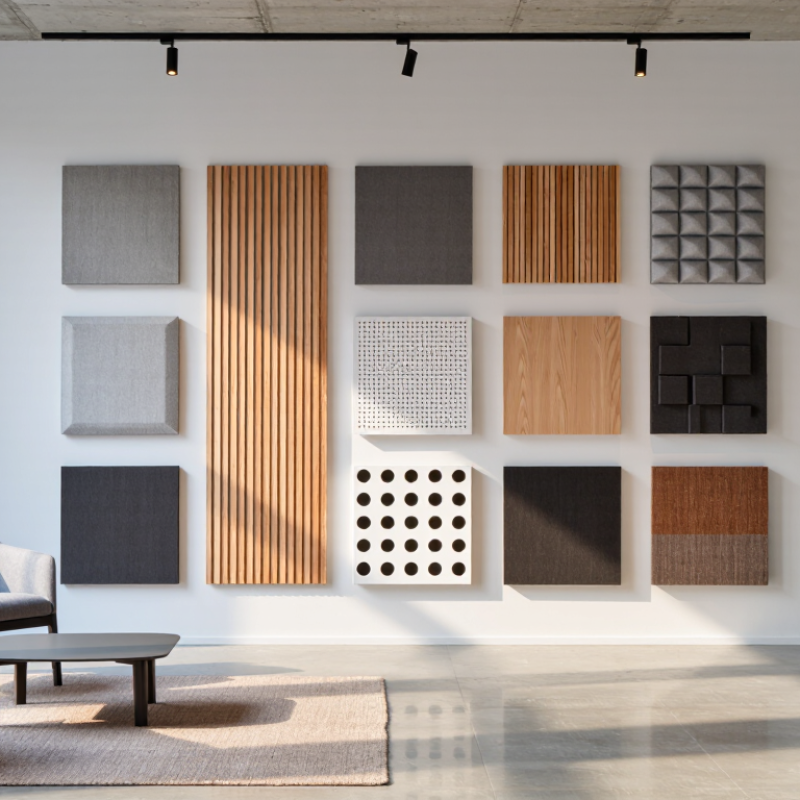
Top 10 Acoustic Wall Panel Manufacturers for Global Buyers

How Acoustic Wall Panels Work: NRC Ratings Use a 0–1+ Absorption Scale

An NRC rating estimates how much sound a tested panel absorbs, not how much noise it blocks between rooms. The scale is generally described from 0 to 1: 0 indicates minimal absorption, while 1 indicates very high average absorption. A reported value above 1 can result from specimen and measurement effects. It does not mean a panel absorbs every sound completely. That distinction matters.

Under the ASTM C423 test method, NRC is calculated from absorption measurements at 250, 500, 1,000, and 2,000 hertz, then rounded to the nearest 0.05. It is a useful comparison, but it does not describe performance at every frequency. A thin panel may reduce sharp echoes while doing little for a low, rumbling HVAC sound.

Panel thickness, backing, air gap, and installation all affect results. A handclap in a furnished room can reveal lingering echo, but it cannot replace laboratory data. Easy to overlook.

When comparing products, global buyers should check the test report and mounting conditions, not just the headline number. Even a high NRC may disappoint if the room has hard floors, bare glass, and too little treated wall area.

I would treat the rating as a starting point, not a promise.

Panel Types and Testing: ASTM C423 and ISO 354 Measurement Methods

Acoustic wall panels differ by how they absorb sound. Fabric-wrapped mineral or glass-fiber panels use porous cores; perforated wood panels rely on openings and an air cavity. Microperforated panels use smaller holes and may suit spaces where exposed fibrous surfaces are undesirable. The detail matters: a 50 mm panel with an air gap can perform differently from the same panel fixed directly to a wall.

ASTM C423 measures sound absorption in a reverberation room and reports frequency-band results. Its Noise Reduction Coefficient averages absorption at 250, 500, 1,000, and 2,000 Hz, rounded to the nearest 0.05. ISO 354 measures absorption in a reverberation room across one-third-octave bands, typically from 100 to 5,000 Hz. These standards provide useful evidence, not a guarantee of identical results in every room. Mounting, sample size, edge exposure, and chamber conditions affect comparisons.

Look beyond one headline number. A high NRC may not mean strong low-frequency control, where bass buildup can persist. Very practical. Check the laboratory report for panel thickness, mounting method, tested area, and frequency-by-frequency values. ASTM and ISO figures should not be treated as directly interchangeable without checking the test setup. It is easy to overlook this point when comparing bids. The numbers are precise; the installation often is not.

Fire and Indoor-Air Checks: ASTM E84 and EN 13501-1 Classifications

For global buyers comparing acoustic wall panels, fire classifications should be checked against the exact product, not a broad catalogue description. ASTM E84 measures surface flame spread and smoke development under specified test conditions. Its Class A, B, or C ratings are not fire-resistance ratings. They do not show how long a wall assembly can withstand fire.

EN 13501-1 classifies reaction to fire, using classes from A1 to F and, where applicable, smoke and flaming-droplet ratings. A designation such as B-s1,d0 gives more detail than the main class alone. Yet ASTM E84 results and EN classifications are not directly interchangeable. Mounting method, substrate, air gap, and adhesive can affect the tested configuration. Ask for reports that match the proposed installation. Details matter.

Fire performance is only part of an indoor-air review. Request current emissions data for the panel and any finish or adhesive, and check what test method and limits the report covers. A low-smoke rating does not prove low VOC emissions. Look for clear test dates, sample descriptions, and independent laboratory documentation. It can be tempting to accept a one-page certificate, but that may omit installation details. Even careful checks leave some uncertainty when site conditions differ from the test setup. Confirming the full wall build-up with the project team is a practical safeguard.

Compare 10 Global Manufacturers by Materials, Customization, and MOQ

A useful comparison of ten acoustic wall panel manufacturers starts with materials, not catalog photos. PET felt is light, easy to shape, and often available in recycled content. Slatted wood panels add warmth, but their backing and spacing affect sound absorption. Fabric-wrapped mineral or glass wool can perform well in offices, though edge details need careful handling. Perforated wood and MDF offer a firmer finish. Ask what sits behind the visible surface.

Customization ranges from standard colors and dimensions to custom profiles, print, edge treatments, and mounting systems. A panel sized for a 600-by-1,200-millimeter wall bay may reduce cutting waste. But a special finish can extend lead time or require a larger production run. Details matter. Request a physical sample and a test report that identifies the panel build and acoustic test method; a single performance number is not enough.

Minimum order quantities vary by material, color, and factory schedule. Some suppliers accept small sample orders, while custom veneers or dyed felt may require higher quantities. Ask whether the quoted MOQ applies per color, size, or total shipment. Confirm packaging, replacement-panel availability, and delivery terms in writing. Small orders vary. A comparison table helps, but it can hide practical differences; even a well-priced panel may not fit the project’s installation sequence.

Top 10 Acoustic Wall Panel Manufacturers for Global Buyers - Compare 10 Global Manufacturers by Materials, Customization, and MOQ

Anonymous supplier profiles for comparing common product categories—not a verified ranking of specific manufacturers. Materials and customization options vary by supplier. MOQ is supplier- and project-specific; confirm it directly before ordering.

Supplier Profile Common Panel Materials Customization Typically Offered MOQ Useful Buyer Checks
1. PET felt panel specialist Polyester fiber felt, often including recycled PET content Cut shapes, color selection, thickness, printed or layered designs Supplier-specific; confirm by size, color, and order configuration Recycled-content documentation, fire-test reports, and installation method
2. Fabric-wrapped panel producer Fabric facing over a sound-absorbing core, commonly mineral fiber or fiberglass Panel dimensions, fabric choices, edge details, and mounting hardware Supplier-specific; custom fabric and colors may affect the minimum Core composition, fabric cleaning guidance, fire performance, and test conditions
3. Wood-slat panel supplier Wood veneer or solid-wood slats, with a felt or other backing layer Slat spacing, panel length, finish, veneer selection, and backing color Supplier-specific; confirm whether orders are calculated by panel or area Wood species or veneer, finish, backing material, and fire classification
4. Perforated wood panel manufacturer Perforated or slotted wood-based panels with an absorptive backing Perforation pattern, veneer or laminate, panel size, and finish Supplier-specific; tooling and custom patterns may influence the minimum Backing specification, tested assembly, and acoustic results for the selected configuration
5. Microperforated panel supplier Microperforated wood, metal, or polymer face with a cavity or backing layer Face material, perforation design, finish, dimensions, and cavity depth Supplier-specific; ask about sample and production-order minimums separately Test data for the complete assembly, not just the facing material
6. Metal acoustic panel producer Perforated metal face with an acoustic infill or backing Metal type, perforation, coating, panel dimensions, and edge profile Supplier-specific; fabrication setup and finish requirements can affect the minimum Corrosion resistance, infill details, fire requirements, and mounting system
7. Foam panel manufacturer Open-cell acoustic foam, commonly polyurethane or melamine foam Thickness, cut profile, dimensions, and selected colors Supplier-specific; stock products and custom cuts may have different minimums Fire-test documentation, intended use, and limitations for the installation location
8. Mineral-fiber panel producer Mineral-fiber or glass-wool core with a finished or fabric-facing surface Dimensions, facing, edge treatment, finish, and suspension or wall-mount options Supplier-specific; packaging and transport may affect order quantities Density, facing, applicable fire classification, and documented test method
9. Custom-printed acoustic panel supplier Fabric-wrapped or PET-felt panels with a printed face Artwork, image scale, panel layout, dimensions, and color matching Supplier-specific; confirm artwork setup, sample, and production minimums Print durability, color proofing, fire documentation, and image-resolution requirements
10. Project-based acoustic panel fabricator A project-dependent selection of fabric, wood, metal, or fiber panels Made-to-measure panels, coordinated finishes, special shapes, and mounting details Usually quoted per project; no universal minimum applies Shop drawings, samples, lead time, installation scope, and project-specific test evidence

Note: Acoustic performance depends on the complete panel assembly, mounting method, air gap, and test method. Request current product data, test reports, certifications, and written MOQ and lead-time terms from each prospective supplier.

Buyer Evaluation Criteria: Test Reports, Lead Times, Warranty, and Total Cost

When comparing acoustic wall panel manufacturers, request complete test reports rather than a single absorption rating. Check the laboratory, test date, panel thickness, backing, and mounting method. Results from ASTM C423 or ISO 354 testing may help, but the tested assembly should match your planned installation. A small air gap can change performance. Confirm whether reported values apply to the panel alone or the full wall setup.

Ask suppliers to separate production time from shipping time. Confirm when the lead-time clock starts, such as after deposit or drawing approval, and request a realistic shipment window. For large projects, ask whether panels will arrive in consistent batches. Review warranty terms for delamination, fading, workmanship, and acoustic performance, including exclusions for moisture or incorrect installation. Get it in writing. A warranty sounds reassuring until its limits are unclear.

Compare total cost per installed square meter, not just the quoted panel price. Include crating, freight, import charges, installation, expected cutting waste, and replacement stock. Request a sample and, where practical, test a small area before ordering for an entire building. This adds time, and project schedules do not always allow it. Still, overlooking finish variation or difficult mounting can cost more than a modest price difference.

Top 10 Acoustic Wall Panel Manufacturers: Buyer Evaluation Criteria

Suggested evaluation weights for comparing test reports, lead times, warranty, and total cost.

Illustrative scorecard weights, not survey results or manufacturer ratings. Adjust them to reflect project requirements, and verify performance claims against product-specific test reports and written commercial terms.

FAQS

How do acoustic wall panels absorb sound?

Porous mineral or glass-fiber cores absorb sound. Perforated wood panels use holes and an air cavity. Microperforated panels have smaller openings. The construction matters.

Does a 50 mm panel perform the same with or without an air gap?

No. A 50 mm panel with an air gap can perform differently from one fixed directly to a wall. Mounting changes everything.

What does the Noise Reduction Coefficient tell me?

The coefficient averages absorption at 250, 500, 1,000, and 2,000 Hz. It is rounded to the nearest 0.05. It does not show every frequency result.

How do ASTM C423 and ISO 354 results differ?

Both measure absorption in reverberation rooms. ASTM C423 reports frequency-band results and an average coefficient. ISO 354 typically covers one-third-octave bands from 100 to 5,000 Hz. Their figures are not automatically interchangeable.

What details should I check in an acoustic test report?

Check panel thickness, mounting method, tested area, edge exposure, and frequency-by-frequency values. Chamber conditions matter too. I still find mounting details easy to miss.

Does a high absorption rating guarantee good bass control?

No. A high overall rating may hide weaker low-frequency absorption. Bass can still build up in a room. Check the low-frequency results.

What do ASTM E84 and EN 13501-1 classifications show?

ASTM E84 measures surface flame spread and smoke development. EN 13501-1 classifies reaction to fire, with possible smoke and flaming-droplet ratings. Neither result alone describes the full wall assembly.

What should I review for fire safety and indoor air quality?

Request reports matching the proposed panel, finish, adhesive, and installation. Check test dates, sample descriptions, and emission limits. A low-smoke rating does not prove low VOC emissions. Site conditions can still differ.

Conclusion

This guide explains how Acoustic Wall Panels reduce reflected sound and improve room acoustics, while clarifying what NRC ratings mean on a 0–1+ absorption scale. It compares common panel types and outlines how ASTM C423 and ISO 354 methods measure sound absorption. Because performance is only one part of a successful specification, the guide also reviews fire classifications under ASTM E84 and EN 13501-1, along with the importance of checking relevant test documentation and indoor-air information.

A comparison of 10 global manufacturers considers materials, customization options, and minimum order quantities to help buyers shortlist suitable suppliers. The final section presents practical evaluation criteria, including the quality and scope of test reports, production and shipping lead times, warranty terms, and total project cost. Together, these points offer a structured way to assess products and suppliers against the needs of a specific space and project.


Aria

Aria

Aria is a dedicated marketing professional with a deep passion for innovative strategies and a keen understanding of our company's product offerings. With a wealth of experience in the industry, Aria excels at crafting engaging content that highlights the unique features and benefits of our......