Explore top-tier profile geometries, co-extruded architectural wall claddings, and acoustic panel assemblies directly supplied by certified manufacturing facilities.
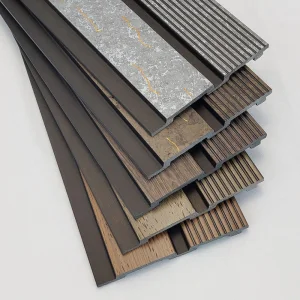
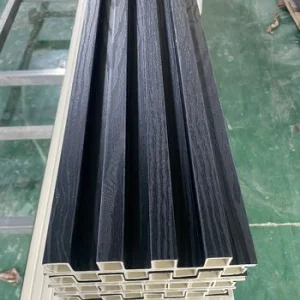
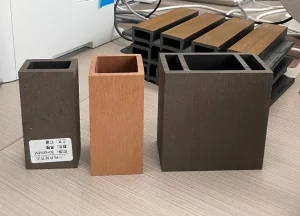
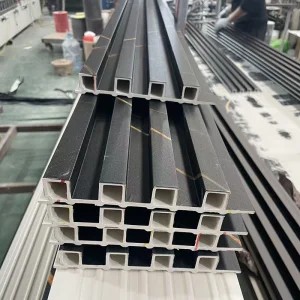
The global demand for Wood-Plastic Composite (WPC) extrusions has experienced a monumental structural shift over the past decade. Projected to expand from USD 8.25 Billion in 2023 to over USD 14.80 Billion by 2030 at a Compound Annual Growth Rate (CAGR) of 8.6%, WPC products are rapidly displacing traditional hardwoods, pressure-treated lumber, and pure synthetic plastics across architectural, residential, and industrial infrastructure projects worldwide.
This trajectory is fueled primarily by strict global decarbonization initiatives, stringent timber harvesting restrictions, and the global construction sector’s imperative to adopt low-maintenance, long-lifecycle materials. Extruded WPC profiles—engineered through a melt-blending of thermoplastics (such as HDPE, PVC, or PP) with recycled bio-mass wood fibers—offer an exceptional synthesis of natural timber aesthetics and polymer durability.
As international buyers—ranging from commercial real estate developers, building material distributors, to architectural design firms—seek stable supply chains, China has consolidated its status as the world's primary hub for high-capacity WPC profile extrusion. Western markets, faced with escalating domestic labor costs and raw material volatility, increasingly lean on Chinese manufacturers capable of supplying custom dies, co-extruded capped profiles, and fully integrated OEM/ODM solutions under rigorous international quality certifications (ISO9001, CE, ASTM, REACH).
To understand why Chinese WPC extrusions achieve superior physical performance, one must examine the polymer chemistry and thermal processing parameters involved during extrusion manufacturing. A standard high-grade WPC profile relies on a carefully matrixed formulation:
Typically utilizes High-Density Polyethylene (HDPE) for outdoor decking and structural cladding, or Polyvinyl Chloride (PVC) for indoor decorative wall paneling and cellular trim profiles. HDPE provides flexural toughness and low-temperature impact strength, while PVC imparts superior fire-retardant (Class B1) properties and dimensional rigidity.
Consisting of 50% to 65% finely ground hardwood flour (60-80 mesh size). The wood fibers are pre-dried to moisture levels below 1% using industrial dehumidifying flash dryers to prevent micro-porosity and structural voiding during high-pressure thermal processing.
Accounting for 8-12% of total volume, including maleic anhydride grafted polyethylene (MAPE) coupling agents for interfacial bonding, Hindered Amine Light Stabilizers (HALS) for UV anti-aging, lubricants for profile skin smoothing, and non-toxic zinc borate for anti-fungal/termite resistance.
Modern global buyers increasingly specify 360-Degree Capped Co-Extrusion. Unlike first-generation mono-extruded profiles which remain exposed to atmospheric moisture and UV oxidation, co-extrusion technology applies an outer protective polymer armor (shield) surrounding the inner wood-composite core during a simultaneous multi-manifold extrusion process.
| Physical Property Standard | 1st Gen Mono-Extrusion WPC | 2nd Gen Co-Extruded (Capped) WPC | Testing Method (ASTM / EN) |
|---|---|---|---|
| Water Absorption (24-hr Immersion) | 1.2% - 2.5% | < 0.2% (Virtually Impervious) | ASTM D570 / EN 317 |
| Flexural Strength (Modulus of Rupture) | 22 - 28 MPa | 35 - 42 MPa | ASTM D790 / EN 310 |
| UV Color Fastness (Delta E after 3000h) | ΔE > 5.0 (Noticeable Fade) | ΔE < 1.5 (High Color Stability) | ISO 4892-2 / QUV Exposure |
| Scratch & Abrasion Resistance | Moderate (Soft surface) | High (Surlyn Polymer Shield) | ANSI A137.1 / Taber Abraser |
| Fire Performance Rating | Class B2 / Class C | Class B1-s1, d0 (Flame Retardant) | EN 13501-1 / UL 94 V-0 |
Understanding China's competitive dominance in the WPC market requires an examination of leading enterprise operations. Headquartered in Linyi City, Shandong Province—the renowned hub of timber processing and building material logistics—Linyi Rich New Materials Co., Ltd. serves as a benchmark for modern automated WPC manufacturing.
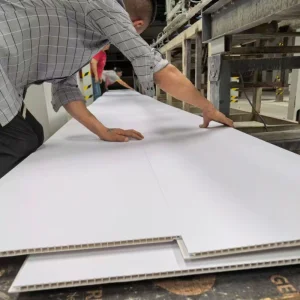
Linyi Rich New Materials Co., Ltd. operates a modernized 100,000 square meter intelligent manufacturing facility. Integrating raw material refining, extrusion line tooling, surface foil lamination, and automated packaging, the complex employs over 300 skilled technical personnel and dedicated quality engineers.
The factory's technical capabilities extend across several advanced material lines engineered for both interior acoustic/wall decoration and structural outdoor architectural cladding:
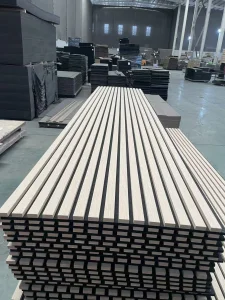
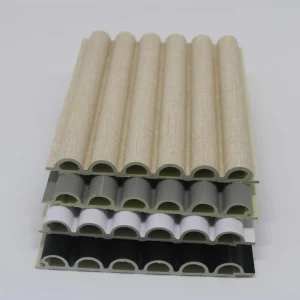
Supported by 120 fully automated production lines yielding an annual capacity of 12 million square meters. Combines authentic wood grain textures with water resistance for interior accent walls, commercial feature ceilings, and hotel lobbies.
Utilizes 40 customized heavy-duty extrusion lines producing 2 million square meters annually. Specially engineered with deep anti-UV anti-aging additives to withstand extreme temperature fluctuations (-40°C to +60°C) across North American and European markets.
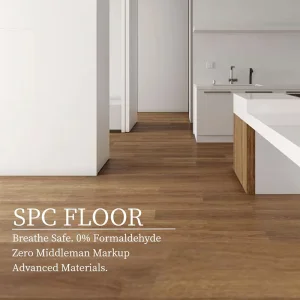
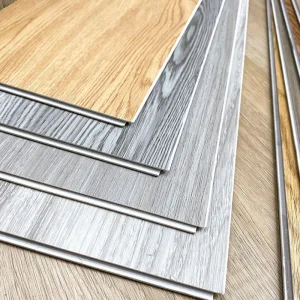
Features 4 high-precision extrusion calendar lines delivering 3 million square meters annually. Incorporates a high-density stone-plastic composite core that achieves 100% waterproof performance, zero formaldehyde emissions, and acoustic sound insulation.
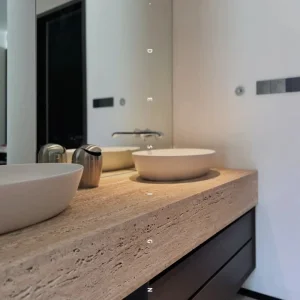
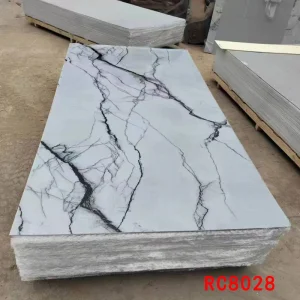
Driven by 12 specialized lines within dust-free cleanrooms, generating 6 million square meters per year. Offers real stone aesthetic reproduction at a fraction of natural marble weight and cost.
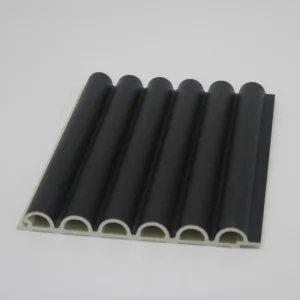
Supported by 6 continuous manufacturing lines generating 1 million square meters annually. Designed for ultra-modern interior wall paneling featuring high impact resistance and complex grooving capabilities.
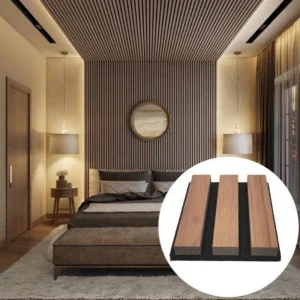
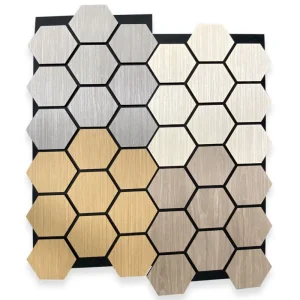
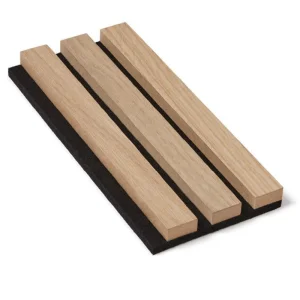
Integrated with precision CNC engraving and automated PET felt backing lines. Engineered to absorb reverberation and improve sound transmission class (STC) ratings in modern architectural offices and residential spaces.
WPC extrusions manufactured in China are engineered to meet global architectural requirements, delivering high performance across diverse commercial and residential applications:
Co-extruded WPC wall profiles function as ventilated rain-screen systems. They mitigate thermal bridging, protect insulation layers from driving rain, and provide high wind-load resistance for multi-story office complexes and shopping centers.
With specialized anti-slip surface texturing (R11 rating) and water absorption below 0.2%, capped WPC profiles resist salt-water corrosion, algae growth, and splintering, making them ideal for coastal promenades and resort pool decks.
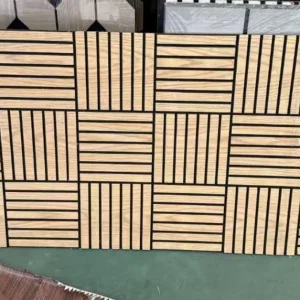
Slotted WPC grating panels combined with recycled PET sound-absorbing backings provide effective noise abatement (NRC > 0.85). Widely deployed in corporate boardrooms, auditoriums, and luxury hotel suites.
Global sourcing managers frequently evaluate the total cost of ownership (TCO) when selecting WPC suppliers. China's continued dominance in extrusion manufacturing relies on three structural advantages:
Linyi, Shandong, represents one of the largest wood-processing and chemical formulation zones in Asia. Factory proximity to polymer resin synthesis plants, wood flour processing mills, and titanium dioxide/additive producers minimizes raw material transport costs and insulates buyers from global supply disruptions.
While Western extrusion die creation can require 8 to 12 weeks, leading Chinese factories maintain in-house CNC tooling workshops. Custom profile dies, clip-lock geometries, and co-extrusion cross-sections are engineered, sample-tested, and mass-produced in under 15 to 20 days.
Operating continuous multi-line production plants (such as Rich New Materials' 120 grating lines) lowers per-unit overhead costs. High-speed continuous extrusion, automated gravimetric dosing, and inline packaging equipment maximize output consistency while maintaining competitive volume pricing.
To safeguard international supply chains, procurement officers must mandate comprehensive factory audits and standardized product testing. Reliable Chinese suppliers maintain full traceability through structured Quality Assurance (QA) protocols:
Verification of virgin vs. recycled PE polymer density, MFI (Melt Flow Index) testing, and automated moisture content verification (<0.5%) before compounding ensures long-term flexural stability.
Laser-caliper gauge tracking during profile draw-off ensures strict tolerance control (+/- 0.3mm) across wall thickness, tongue-and-groove fit, and profile length specifications.
Finished profiles undergo thermal shock cycling (-30°C to 70°C), boiling water immersion tests for internal bond strength, and QUV accelerated weathering to verify 15-to-25-year structural warranties.
Addresses key operational, technical, and commercial questions raised by international buyers and architects sourcing WPC extrusions from China.
Review specialized composite profiles, soft stone veneers, acoustic slat products, and UV-coated wall systems available for export shipment.
Whether you are developing large-scale commercial real estate project facades, expanding your national wholesale building material distribution network, or creating custom OEM composite profiles, Linyi Rich New Materials Co., Ltd. delivers global supply reliability, rigorous quality control, and competitive direct factory pricing.
 Rich New Materials